Tuesday, July 31, 2012

Colbert on the London Olympic Opening Ceremony


Stephen feigns right wing outrage at their tribute to the socialist National Health Service set up after Winston Churchill was voted out of Number 10 Downing Street (the British Prime Minister's residence) after World War II.

Sunday, July 29, 2012

PodCamp 7 is Coming


Two Weeks ago I posted on a workshop being held by PodCamp called:

What's a Tweet? And what's all this Twitter about? : Computer Class

This was a good class for beginners on twitter that was held at the Carnegie Library last month.  On October 27 & 28 PodCamp Pittsburgh will be holding  what they call an unconference for those who want to learn about how to use social media to for online activism, to promote one's business, or for any other activity of interest at Point Park University.  I've embedded the basic class on Facebook and Twitter from last year above.  Attendance is free.  Last year there were sessions for nonprofits, political blogging led by Rep. Mike Doyle, and many others on the potential and pitfalls (remember Sarah Palin's death panels?) of social media.  

There is a generational divide between young and older activists in the use of social media to bypass the lamestream media filter.  There is a national conference for progressive activists called Netroots Nation which will be in San Jose, CA next year.  PodCamp is not political per se but it does teach skills that can be used by anyone and is more accessible.  Individuals of all political stripes attend.  There are similar PodCamps in Wilmington, Delaware in September 28-30 and other cities around the world.  I encourage you all to attend and bridge the digital divide.  Here is an interview that was posted that I did the night before the last PodCamp.


Social Media in Four Questions, Interview #12 from Eric Williams on Vimeo.
**Related Posts** 

PodCamp Pittsburgh 6

Thursday, July 26, 2012

If Vermont Won't Have Single Payer What Will it Have?


Wednesday night I was at a meeting of the Western Coalition for Single Payer Healthcare (a group in Western PA campaigning for a national single payer plan to be enacted).  The subject of state efforts to enact single payer came up.  I said that there were efforts in several states to enact it and Vermont passed it two years ago.  A member objected saying that Vermont's plan is not single payer because it's administered by Blue Cross.  This made me ask myself what a single payer system is.

I looked at the Vermont for Single Payer website and they do have a definition saying that "health care is financed by the public whose money is managed by the government or by a government sanctioned agency... (the full definition can be read here)."  If the government of Vermont indeed has sanctioned Blue Cross to administer their plan in a nonprofit capacity then it does meet their definition of single payer.  As TR Reid in the documentary Sick Around the World shows there is considerable variability in health care systems around the world.  Germany, Japan, and the Netherlands have systems which are administered by private insurers but heavily regulated by the government.  Does that count as single payer?  According to Vermont, yes.


Watch Sick Around the World on PBS. See more from FRONTLINE.

Canada, the United Kingdom, Cuba, and Taiwan have healthcare systems which are administered directly by the government.  This I believe is the type of single payer system which those at the Western PA Coalition would prefer.  While there are good reasons to be suspicious of the intentions of Blue Cross or UPMC.  We won't really know how it works until it is fully implemented.  

We do have working models in other nations for universal non profit systems, They are all good systems with outcomes comparable to Canada's.  The commonwealth fund has studies which show that their health and cost outcomes are roughly equivalent with the US for profit system trailing.  If you double click on the image with some comparisons between the US and other countries below you can enlarge it.

I go to discussion groups like Drinking Liberally where many on the left do not really understand what single payer is.  They ask me questions like "doesn't Massachusetts already have it?"  I tell them no because it leaves the for profit nature of the current system intact which drives up the costs.

  **Related Posts**


WaPo Interactive International Cost Graphic


STOP Obamacare in Pennsylvania: Where We Agree with Them


Aaron Carroll's Analysis of Single Payer and Wait Times


Protecting the Parasites: The Irony of Obamacare


Wednesday, July 25, 2012

Medicare and Medicaid Are superior to private insurance in certain ways

We hear so often that medicare and medicaid are unable to provide care to patients in the way that privately funded care does, as an argument for privatizing both of them.  The logic goes that if they are not as good, then let's just do away with them.  However, this is simply not true.  The two articles included address two very different aspects of these plans, but both are crucial to understanding them.  In the first (you will have to copy and paste to read it) you will find that when 3 states that expanded medicaid were compared to 4 that did not, outcomes were superior in the former.  In the second, those on medicare were more satisfied with their health care than those in private plans.  Time and again, with equal access, private plans fall short.  It is time that we Enhanced Medicare and provided adequate funding to Medicaid, to strengthen these safety nets, instead of gutting them.  Enhanced Medicare for all is not the problem but the solution.  
 

http://online.wsj.com/article/SB10000872396390444840104577549311758980038.html?mod=googlenews_wsj

http://bit.ly/OSqb2k

Saturday, July 21, 2012

You can Sacrifice the Good for the Perfect

http://www.counterpunch.org/2012/07/16/blame-single-payer-advocates/

As a single payer advocate for nigh on to 2 decades, no one wants to reach a national Single payer system more than I.  What we got in the Affordable Care Act was really not much.  Unless you are a young person who can stay on their parents' insurance.  Or someone with a malignancy who was nearing a lifetime limit.  Or a person who has a preexisiting condition.  All of these examples represent millions who are benefited by the ACA.  But we want more.  We want EVERY person to have cradle to grave coverage.  We want everyone who is employed, unemployed, in between jobs, retired, not yet of working age, and everyone else to have health care.  And we want that health care to be the best that this country has to offer.  A baby in a poor area of town should not have different care from one in an affluent area.  What the ACA showed was that a national plan CAN be passed, that we CAN get a national health care system.  Those of us working at the state level for single payer never question that HR 676 would be better than going state by state.  But it was not in the cards.  Yes, it was thrown out before the negotiations even started, and that was stupidity, pure and simple.  The right has shown that they were not going to compromise, so why start in the middle and work towards the right.  The left, those democrats willing to be so labeled, and progressives should have pushed for single payer all along.  Many of us did.  But our voices were drowned out by the vocal minority of the right who want no health care reform,  the MEMEs.  They are the ones with their socialized fire department, their socialized police department, their socialized FDA protecting their drugs, their socialized EPA keeping their air and water clean, who don't want to have anything to do with a government funded health care system.  We need to ignore them, because they are clueless.  Now that we know that we can pass legislation nationally, that is far from perfect, we know it can be done.  Let's do it right the next time. 

Friday, July 20, 2012

Why Don't Republicans support Single Payer???


It is very hard to understand whey everyone doesn't support a single
payer system in health care. If someone wants to save money, wants to lower 
society's overall cost, improve access, then there is no other system. 
The only group in our society which does not fear bankruptcy, does not 
worry about lifetime cost, does not worry about preexisiting conditions
is that of those over 65. So what we should do is strengthen and enhance
Medicare, not gut it, or equally bad, privatize it, as a small but very
 vocal minority wants to do. 

Thursday, July 19, 2012

Chuck Pennachio to be on WCAN Radio

 
Reminder: for forwarding and posting: Chuck on national radio show to discuss "Life After the Affordable Care Act: Politics, Money, and What You Can Do" to achieve comprehensive, universal healthcare.

Tune in, call in, brainstorm! 


clip_image002

JULY 19TH
8:30 PM EASTERN TIME
My guest will be Chuck Pennacchio, Executive Director of Health Care 4 All PA.   Chuck and I will discuss the Supreme Court decision on the Affordable Care Act, the history of health care reform in the US and why we are struggling so hard with this issue as well as the political realities that make the campaign harder.  
To listen, go to http://www.wcanradio.com/ and click on the microphone to listen.  You do need Windows Media Player. 
Join the discussion by calling 1-800-921-2204 or e-mail questions and comments to wcanradio@yahoo.com.

Please let your constituencies know about the show.

Thanks,
Debbie Silverstein

Tuesday, July 17, 2012

Rebecca Pruveadenti's Letter Published in the Erie Times

 Profile Picture

This Letter was published in the Erie Times on July 15th Single-payer still best system.  It was written by Rebecca Prudevanti of the NW Healthcare for All PA Chapter.

The Affordable Care Act (ObamaCare) was upheld by the Supreme Court and many on the left are unhappy with the ACA and President Obama. This law helps keep an unsustainable, for-profit, health insurance industry in place and calls it health care. It does nothing to control spiraling costs and will spur this country's next financial crisis because it is growing three times faster than the U. S. economy.

The current system is responsible for causing medical bankruptcies -- 50 percent of all U.S. bankruptcies. The health insurance industry acts as a toll booth between you and your health care. When you get sick and begin to use your insurance, you must stop, ask permission, pay to get through. Sound like a privilege or extortion? Single-payer supporters are incensed that a sensible, single-payer solution to heath care in this country is viewed as evil, yet denying health care to a human being is the right thing to do.

Currently, the U.S. has Medicare, a single-payer plan for people over 65; Medicaid, a single payer plan for people under the poverty level; the VA Health System, true "socialized" medicine yet essentially a single-payer plan for veterans and their families; and the for-profit health insurance industry system for whoever can afford it. The most expensive and least effective for "we, the people" is the for-profit model. For-profit means profit at all costs, ignoring all moral imperatives regarding the sanctity of life because it lowers the corporate profit ratio.

The absence of equal access to health care is directly linked to an unhealthy, uneducated populace. A single-payer system where everybody pays in and gets equal access to health care is the sensible solution.

Rebecca Pruveadenti president, HealthCare4All PA, NW Chapter

Friday, July 13, 2012

States of Confusion

Medicaid expansion is a critical part of the Affordable Care Act (ACA). Of the approximately 30 million people who are currently uninsured, but will be if the ACA is fully implemented, fully half of them—the poorest half—will be insured through the Medicaid expansion.

Traditional Medicaid is jointly administered by the state and federal governments. The Feds set some basic rules. All children are covered if their family makes less than the federal poverty level. Children under six are covered up to 133% of the poverty line. But the states set the eligibility rules for adults. In most states, if you don't have children, you can't qualify for Medicaid no matter how poor you are. In states like Texas and Louisiana, parents only qualify for Medicaid if they make less than 40% of the federal poverty level—$4850 a year for two parents with a single child. Other states are more generous. Massachusetts, thanks to Romneycare, covers all adults up to 133% of the poverty line. But on the whole, Medicaid as currently implemented is not much of a safety net for the poor. Right now, the federal government pays on average 57% of the cost of traditional Medicaid—between 50% and 75%, depending state eligibility rules.

The ACA expands Medicaid by making everyone—children and adults—eligible for Medicaid if their family income is 133% of the poverty level or lower. This is expensive, so the Feds agreed to pay most of the cost. In 2014, they will pay 100%. This drops to 95% in 2017, and to 90% in 2020. Notice that states that whose current Medicaid eligibility rules are relatively stingy—which tend to be the states with the highest percentage of uninsured citizens—stand to gain more money per capita when from the Medicaid expansion than states whose eligibility rules are generous. Texans will make out like bandits if they accept the money, while Massachusetts residents will get nothing, since they are already covered up to 133% of the poverty line.

This is another example of a little-known source of inequality in our national politics. As I previously pointed out, conservative states—states that are more rural, have a lower median income, and tend to vote Republican—receive more money back from the federal government than they pay in taxes. Liberal states get shortchanged. In fact, you could argue that much of U. S. domestic policy involves a redistribution of income in which the “blue states” subsidize the “red states.” (Note: They're not grateful.)

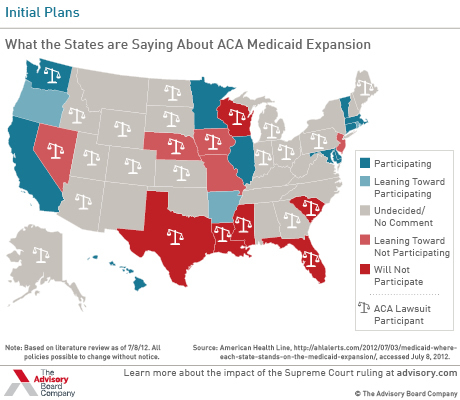
Enter the Supremes. The ACA required states to implement the Medicaid expansion. If they refused, the federal government threatened to withhold its contribution to traditional Medicare. Chief Justice John Roberts, in National Federation of Independent Business v. Sebelius, ruled that this was coercive, and that the states may opt out of Medicaid expansion. Six Republican governors have already said that they will refuse to comply, and several others are threatening to do so. Here is the map. The chart below it shows that, with the exception of Wisconsin, the states that plan to refuse the Medicaid expansion have a higher percentage of uninsured citizens, or in other words, have more to gain from it. This will not only frustrate the intent of the ACA, but will deny medical help to many of the Americans who need it most.


To make matters worse, some Republican governors have announced that they are exploring the possibility of dropping out of traditional Medicaid as well. They interpret the Supremes' decision to mean that they can opt out of any federal program that requires the states to pay part of the cost. The states' reaction to Medicaid expansion makes it very clear that attempting to implement health care reform at the state level is an exercise in futility.

The usual reason given for why conservatives refuse to expand Medicaid is said to be conservative ideology. This is most charitably described as opposition to big government, but when applied to health care, it sounds suspiciously like an unwillingness to help one's fellow citizens who can't afford medical care, either because they are poor or because their family is struck by catastrophic illness. Are there rational reasons for refusing to expand Medicaid?
  • The 5% (in 2017) to 10% (in 2020) of the cost of Medicaid expansion is not exactly pocket change. States may be justifiably worried about the cost.
  • The “woodwork effect.” Many Americans who are eligible for Medicaid in their state don't apply for it. They may think it's not worth the trouble. However, the publicity surrounding the Medicaid expansion and the threat of a fine for violating the individual mandate may persuade more eligible people to sign up. The states will then be on the hook for whatever part of the cost they would have had to cover under traditional Medicare.
Many health care policy experts, however, think that the financial logic of expanding Medicaid is strong enough to overcome any resistance due to ideology. Here are some of the points they make.
  • Not only will it be difficult for states to turn down “free money,” the citizens of those states that turn down the Medicaid expansion will be paying for it anyway through their federal taxes. Their money will go to other states that have accepted the deal (partially reversing the flow of money from blue states to red).
  • As noted above, the states whose governors have been most vocal about opting out of Medicaid expansion are the ones that stand to gain the most from it, since they have a higher percentage of uninsured citizens.
  • Uninsured citizens in these states will continue to show up at hospital emergency rooms. Their care will be paid for through cost shifting. Costs are shifted in several ways.
  • Some of the cost is paid by those who have health insurance. Their premiums are higher in order to pay the cost of treating people without insurance.
  • Part of the cost is paid for through federal, state and local taxes, which provide emergency health care for the poor. The Urban Institute estimated that in 2008, state and local governments spent $10.6 billion dollars providing emergency care for the uninsured. However, beginning in 2014, the federal government will no longer subsidize emergency care, so the burden will fall more heavily on state and local government. This cost alone will probably be greater than the cost to the states of Medicaid expansion.
  • Finally, part of the cost is shifted to hospitals through what is called “forced charity”—uncompensated medical care for the uninsured. (Of course, they get some of this money back by charging you or your insurance company $28 for a box of tissues while you're in the hospital.)
  • Low income citizens and the public interest groups that represent them will protest the denial of coverage to hundreds of thousands of poor and sick people. However, research at the federal level shows that the attitudes of poor people have either no influence, or a slight negative effect, on public policy. This is probably true at the state level as well, but this remains to be demonstrated.
  • Most importantly, hospitals and doctors were expecting to have many more customers due to Medicaid expansion. They've already agreed to reduce their reimbursement rates under the ACA, in anticipation of these higher profits. They're also not happy about forced charity. Health care providers are powerful lobbying groups who spend a lot of money paying off governors and state legislators. They won't take this loss of revenue lying down.
What will happen? Nothing, until after the election. Given how unpopular the ACA is, anything the Republicans can do to resist it now will probably help them in November. If Romney defeats Obama and the Elephants gain control of the Senate, it's probably all over for health care reform for at least a decade.

If that doesn't happen and the ACA survives, it seems inevitable that all the states will eventually agree to expand Medicaid. However, that will take a long time and a lot of people will die while they're waiting for it to happen.

Nurses Cross California to Promote Guaranteed Healthcare


Nurses are traveling throughout California to promote Medicare for All. Nurses are on the front lines every day with patients who cannot afford care. Now President Obama's Affordable Care Act mandates…
00:02:17
Added on 7/11/12

Tuesday, July 10, 2012

States not participating in Medicaid Expansion So Far


Texas now added itself to the five other states above in dark red which will not participate in the ACA medicaid expansion even though it leads the nation in the percent uninsured at 26.3% and is correlated most strongly with income and the % Latino population at the county level. Here is Texas Gov. Rick Perry's justification:


Pennsylvania is listed in the top graphic as undecided toward participating.  Ezra Klein believes all states will eventually sign up as they are reimbursed.  The right graphic shows four of the six states, Texas, Florida, Louisiana, and Mississippi, having having some of the highest within 200% of federal poverty (Mississippi, try living on that governors) and uninsured (Texas) rates in the US. South Carolina and Wisconsin had  19.4% and 10.6% uninsured rates and 30.9% and 20.9% 200% poverty rates in 2009 respectively.

**Related posts**


Latino Rates in Pennsylvania's Uninsured 


The Supreme Pennsylvania Medicaid Decision


Rick Perry's Efforts to Save Us All 


A Statistical Profile of the Uninsured in Washington, DC, New Mexico, and Texas

What's a Tweet? And what's all this Twitter about? : Computer Class

I am often asked to show individuals how to use Twitter, Facebook and/or Blogspot.  Podcamp provides free classes on these topics.  This can be an effective tool in supporting nonprofits as well as relationships and business.  This next Wednesday, July 18, they will be having a free class on how to use Twitter I recommend that all who are interested attend.

Wednesday, July 18, 2012  
6:00 PM - 8:00 PM

This mini-session of PodCamp Pittsburgh--a local annual conference about information sharing online--will introduce you to some of the most popular social networking tools. Learn why Twitter is being used in personal relationships and business. Don't have an account? We will set you up! Please feel free to bring your phone or laptop if you need help setting up and we'll walk you through.
Presented by: Michael
Event fee: Free
Sponsor: PodCamp Pittsburgh
Location:
4400 Forbes Avenue
Pittsburgh, PA 15213

Contact:
PC Center Staff
412-578-2561
pccenter@carnegielibrary.org


Registration is required for this event.
You can register by calling 412-578-2561 or by filling in the form below and clicking on the Register button.

Friday, July 6, 2012

The ONLY Answer.

This Oped piece appeared in the Erie Times.

Why Pennsylvania should opt for single-payer health system

When asked, almost all Americans will say that access to health care is of major concern to them. But access means different things to different people. For some who have chronic illnesses, it is how to pay for the continuing costs of treating the illness. That may mean paying for health care insurance and its deductibles and co-pays, or it may mean having the ability to acquire health care insurance even if cost is not an issue. For others it may mean having the ability to manage one's own health care along with their medical professionals and not having to subject themselves to the dictates of the health insurance carrier.

Those who do not have health care insurance and do not have the financial ability to pay for it must live in the constant fear of injury or illness, which would devastate their personal finances and potentially destroy the economic future of themselves and their family.

There is no question that this country has the finest medical care in the world. Our ability to identify, manage and treat injury and disease is without peer. But, all of that is valueless if one does not have access to the system. While it is true that everyone will ultimately be treated, even if they do not have health care insurance, it is not free. Someone has to absorb the cost. That normally means that doctors, hospitals, government and insurance carriers (through higher premium costs for their policy holders) all share the costs in some proportion.

In March 2010 Congress passed the Patient Protection and Affordable Care Act. This landmark legislation addressed some health care issues, but also left many questions and legal challenges. The U.S. Supreme Court has upheld the constitutionality of the act which means that the various provisions will continue to be implemented, mostly by 2014 but also continuing through the end of the decade. One provision is that states may propose their own innovations in health care, provided that those innovations do not fall below the requirements of the PPACA. As the law is written, this cannot occur until 2017.

In Pennsylvania citizens from all walks of life have banded together in an organization known as Health Care 4 All PA. We believe that resolution of the health-care issue begins with allowing the states to adopt health-care programs tailored to the needs of their residents. Moreover we believe that a single-payer system is the most cost-effective and economical method of delivering that health care. Research data and economic analysis supports that conclusion. Huge costs of the present health-care system are eliminated through reducing or eliminating extensive administrative, marketing and management costs.

Single-payer means, simply, that every Pennsylvania citizen would be provided health care with the expectation that every citizen and every business would contribute to its cost. It is clear that those costs would be significantly less in total than the costs of the current system, which leaves many Pennsylvanians without health care protection.

Our organization is committed to moving forward with a single-payer model and to be prepared to join other states including Vermont, Hawaii, Montana and Washington by 2017 with the implementation of the proposal.

Legislation has already been introduced in the Pennsylvania House (HB 1660) and Senate (SB 400). Even though PPACA is now the law of the land, it still leaves many Americans and many Pennsylvanians unprotected. Therefore, now is the time for new efforts and new ideas to ensure that all of our citizens have the comfort of knowing they will be able to utilize the best health- care system in the world when they need it.

But it will not happen until and unless the people of Pennsylvania make it happen. Learn about the single-payer option. Study the alternatives and then decide what works best for you and your family. Finally, contact your state representatives and state senators and ask them for their ideas. Remember that this is an election year. They will listen. Ask them to support and fight for the health- care solutions that will benefit every Pennsylvanian.


DAVID STEIL, of Yardley, is president of Health Care 4 All PA and owner of a manufacturing business. A Republican, his 27 years of experience in government includes serving as township planning commission, a township supervisor and in the Pennsylvania House of Representatives.

Does Propaganda Work?

First of all, before you read any further, you have to take this pop quiz on the Affordable Care Act (ACA) written by the Kaiser Family Foundation.

Finished yet? O.K., now you can read Kaiser's analysis of the results. You'll find that less than 1% of respondents got all ten items correct. I was one of them, which is why you people should listen to me when I'm talking!  ;)  You'll also find that people who got fewer correct answers were (among other things) more likely to be Republicans, watchers of Fox News, and in favor of repealing the law.

Kevin Drum has constructed the following chart. He points out that there has been more conservative disinformation regarding the five items that more people answered incorrectly than the other five. This suggests that the right wing and their media enablers have been effective in misleading the public about the ACA.


I'm not sure I buy Drum's argument, since he has no data on how frequently false claims were made. I don't recall hearing that much about the nonexistent mandate that small businesses offer coverage to their employees, for example. Of course, there have been more complaints about the individual mandate than any other provision of the ACA, but in this case, the conservatives have not lied about it. There really is an individual mandate, although they have neglected to point out how small a percentage of Americans will be affected by it.

In order to get these results, you need more than just conservative propaganda. You also need corporate news media that fail to correct it, media that present these false claims as a he-said-she-said “controversy,” without explaining who is right and who is wrong.


Update

Thanks to Paul Ricci for pointing out that paid advertisements have almost certainly been a major factor in spreading public misinformation about the ACA. On June 20, The New York Times added up the expenditures to that date.

The amount spent attacking the ACA ($235 million) was 3.4 times the amount spent defending it ($69 million). Almost all the pro-ACA ads were from the Department of Health and Human Service ($47 million)--ads which the Times describes as “bland, explaining aspects of the law.” The anti-ACA ads come largely from the usual cast of Elephants who have emerged as major players in the post-Citizens United ad wars—the U. S. Chamber of Commerce ($27 million), Karl Rove's Crossroads USA ($18 million), etc. As part of the captive audience for these ads, I would not describe them as bland. The anti-ACA ads play to people's fears about government takeovers (“socialism”), rising deficits, and the rationing of care.

The anti-ACA ads have played primarily in swing states such as Florida, Pennsylvania and Ohio, suggesting that they are, in part, an early start to the presidential campaign. Many readers of this blog have seen these ads, since they live near Pittsburgh, the fourth largest market for these ads ($7.6 million), or Philadelphia ($7.9 million), the second largest market.

Chuck Pennacchio One Payer State Report

Statement from Executive Director Chuck Pennacchio on the One Payer State Meeting


Filmmaker and citizen activist Michael Moore (SiCKO, Bowling for Columbine, Roger and Me, Capitalism: A Love Story) graced Philadelphia last Saturday for a five-year reunion of SiCKO's release, the third-highest grossing documentary ever that revealed the tragedy of under-insurance in the United States. Also assembled were seven of the film's health insurance industry victims (including our own Donna Smith), and two industry whistle-blowers who continue to expose the medical-industrial-complex's profit-first methods of maximum money-making.

In addition to the emotional sagas of PREVENTABLE suffering that continue to this day - 9/11 rescue worker with oxygen tank, parentless teen, widowed spouse, morphing cancers, running battles with insurance companies, medical bankruptcies - Wendell Potter (author of "Deadly Spin") shared his crisis-of-conscience journey to 'industry whistle-blower,' beginning with his former company, CIGNA, assigning him, stealthily, to sneak-preview "SiCKO" in Sacramento and plan the public relations attacks on the movie.

Michael Moore then used story, movie-making insights, and outrage over right-wing bullying and Obama-enabling to illustrate, on the one hand, SiCKO's educational and motivational benefit and, on the other hand, the watered-down Affordable Care Act that the Supreme Court validated last week. At the same time, Michael (and Wendell) chastised single payer activists inclined to look past the significance of corporatist Chief Justice Roberts siding with the Court's more liberal members, and permitting ACA's implementation (minus the force of withholding Medicaid funding for states that refuse to accept ACA minimal health standards).

During a pre-event reception at Healthcare-NOW's William Way Center auditorium, the 300-person public event at Plays and Players Theater (sans air-conditioning on a sticky night!) near Rittenhouse Square, and the day following at our 22-member, 'One Payer States' all-day conference, speaker after speaker, discussant after discussant, emphasized the opportunity presented by ACA's continuing implementation. We need to celebrate (Moore), exploit (Michael Lighty, CA Nurses), understand our challenges, challengers, and potential allies (Brigitte Marti, Dr Carol Ritter, Mark Dudzic, Pennacchio), strategize (Potter), and organize (Francesca Lo Basso, Smith).

Specifically, our best opportunity for translating ACA passage and SCOTUS ruling into universal healthcare is embedded in the national legislation itself. That is, ACA contains provisions for state-based healthcare innovation and funding waivers (can you say "Single Payer six times straight"...six times?), already endorsed by President Obama, embraced by numerous Republicans at all levels of government, and led by Independent Senator Bernie Sanders (VT) and Democratic Representative Jim McDermott (WA) in the United States Congress.

So now it's on us, to build on the week's and weekend's successes, energy, inspiration, and more, to turn ACA into state-based Improved Medicare for All as the next step to achieving true, universal single payer healthcare for each and every person in America. Every body in, no body out.

Onward to the Proven Single Payer Solution.

Chuck Pennacchio, PhD
Executive Director
Healthcare4AllPa.org
Co-Founder, One Payer States Network

Thursday, July 5, 2012

BRAINSTORM for SINGLE-PAYER at PUSH/SW PA HEALTHCARE4ALLPA

10am to 11:15am, Saturday, July 14, PUSH/SW Healthcare4ALLPA will gather in the back room of PANERA BREAD on the corner of the BLVD of the ALLIES and HALKET ST. in OAKLAND. 3401 Blvd of the Allies, Pittsburgh,PA  15213 . PH: .412-6839616 for a BRAINSTORMING SESSION on planning FUNDRAISERS, EDUCATIONAL EVENTS, and JOINING with like minded MOVEMENTS in promoting the only affordable, moral, comprehensive health care, one-payer, medicare for all in PA.  Everyone is invited.Please bring your appetite and new ideas!
Please note, there will be no PUSH/SW Healthcare4ALLPA Steering Committee Meetings in July or August.

Wednesday, July 4, 2012

The Supreme Pennsylvania Medicaid Decision

Little noticed in all of the celebrating over the Supreme Court's decision was the part of it that said that the federal government cannot take away federal funding for states that refuse to implement the Medicaid expansion that is contained in the Affordable Care Act.  States will be reimbursed for the expansion 100% in 2014 with decreasing amounts to 95% in 2017 and 90% in 2020 according to the Pittsburgh Post-Gazette.  Pennsylvania Governor Tom Corbett(R) hasn't said if he will participate the expansion which could cover about an additional 800,000 of the state's estimated 1.4 million uninsured in 2009.  So far the governors of Florida, Louisiana, and South Carolina have said that their states will not participate in the expansion even though about 900,000 and 300,000 would become eligible in each state respectively.

Can past behavior on Medicaid in Pennsylvania be an indication of how Gov. Corbett will act?  In January I did a post on how about 88,000 children were dropped from the Medicaid rolls due to a bureaucratic backlog.  Greg Kaufman in The Nation magazine reports that number to be 89,000 and they still have not been reinstated and were not picked up by the CHIP program. Corbett's decision to end Adult Basic coverage for 45,000 Pennsylvania adults may provide an indication as well.


Right after the Supreme Court announced its decision on Thursday David Cole at The Nation said on Democracy Now! that "we shouldn't let the perfect be the enemy of the good."  I say we shouldn't let the lousy be the enemy of the good either.  A system that mandates care for all is what is needed as Walter Tsou points out in Common Dreams.


**Update**

The Facebook page Stop Obamacare in PA (111 likes) is circulating a petition urging Gov. Corbett not to implement any of the Affordable Care Act which can be seen here.  I do not know how many signatures they have and am not going to sign it but this could also be a good test case for how much leverage does the Tea Party have with the Governor. 

**Related Posts**


The Friday Morning Quarterback 

Protecting the Parasites: The Irony of Obamacare

The Pennsylvania Medicaid Budgetary Squeeze