Showing posts with label Economics. Show all posts

Wednesday, May 28, 2014

Change in Bankruptcy and Health Outcomes


Rotated Factor Matrixa

Factor
1  (52% of Variance)
2 (21% of Variance)
Infant Mortality 2007 Deaths/1000
.915
.157
Life Expectancy
-.824
-.473
% Low Birthweight Babies
.700
.341
Groups per million
.612

% change in bankruptcy
-.441

Percent Uninsured in Demographic Group for All Income Levels

.979
Percent under age 65 in 200% of Poverty
.372
.753
Extraction Method: Principal Axis Factoring.
 Rotation Method: Varimax with Kaiser Normalization.a
a. Rotation converged in 3 iterations.

I've added the change in bankruptcy rates to the factor analysis for health and hate groups.  I had to remove income from the analysis so the model would converge.  The factor structure did not change radically otherwise.  The % change in bankruptcy loaded weakly and negatively on the factor with health outcomes and hate groups.  Of all the factors entered, life expectancy correlated most strongly with the % change in bankruptcy followed by infant mortality. 


The graph for life expectancy suggests a positive relationship with the change in bankruptcy.  The increased change in bankruptcy could be due to more permissive laws in granting bankruptcy protection from creditors as can be seen in the video below.  These states may tend to have better quality of life characteristics than those who do not.  For example, Hawaii had the highest life expectancy and an increase in bankruptcies of 129% (and zero hate groups).  As can be seen in the above graph, this relationship is far from perfect accounting for only 15.2% of the variability,


There is also a significant negative correlation with infant mortality and change in bankruptcy accounting for 13.4% of the variance.  The District of Columbia is an outlier with a rate of 13.1 deaths per 1,000 live births but an increase of 26% of bankruptcies (DC also has the highest rate of hate groups)/  Removing DC gives a slightly stronger relationship with 14.9% of the variability accounted.

**Related Posts**

A Wave of Hate Groups in California? No in Washington, DC


How do the States Stack Up on Infant Mortality? (Cross Post with PUSH)


Correlation with the Number of Hate Groups per Million, Poor Health Suggests More Hate


Personal and Medical Bankruptcies: A Follow Up


Income and Life Expectancy. What does it Tell Us About US?

Monday, March 3, 2014

NEW ECONOMY CELEBRATION! Panels,Workshops,Marketplace,Catalyst Awards

The New Economy Working Group is having a celebration of innovators with panels, workshops, and awards on March 20-22 at Baker Hall on the Carnegie Mellon University Campus and other locations.  Details are below.  A single payer system is integral to a new/more efficient economy as Dr. Gerald Friedman showed in his economic impact study.

REGISTER for these FREE EVENTS here:
>>> Thursday March 20 - NEWG Sponsors MARCH GREEN DRINKS ! http://tinyurl.com/NEWG-green-drinks

>>> Friday March 21 - Seminar with Gar Alperovitz: http://tinyurl.com/NEWG-solutions

>>> Friday March 21 - Evening Discussion with Gar Alperovitz: http://tinyurl.com/NEWG-gar-discussion

>>> Saturday March 22 - All-Day Events: http://tinyurl.com/NEWG-Sat-Mar-22

A showcase of Pittsburghers’ efforts to create an economy where the benefits are equitably shared between business employees or employee-owners, stakeholders, and host communities; creates strong, nurturing social ties; and replenishes nature.

See http://www.NEWGPGH.WORDPRESS.COM/ for more information on the Pittsburgh New Economy Working Group.

A featured appearance from Gar Alperovitz, a leading voice in the nationwide new economy movement.
People who attended October 2013's "Unconference" are planning resources, projects, and event activities now.

THURSDAY MAR 20: NEWG sponsors "Green Drinks" 5-9 PM @ The Map Room
FRIDAY MAR 21: 2 PM @ Frick Fine Arts Building, PITT
FRIDAY MAR 21: 5 PM @ CMU Baker Hall Adamson Wing
SATURDAY MAR 22: 9 AM - 4 PM @ CMU Baker Hall Giant Eagle Auditorium


**Related Posts** 


Video from the Friedman Pittsburgh Talk is now Available 


Thursday, August 29, 2013

State of Working PA: Slowing Job Growth, Falling Wages Impede Recovery (and The Drop in Uninsured)


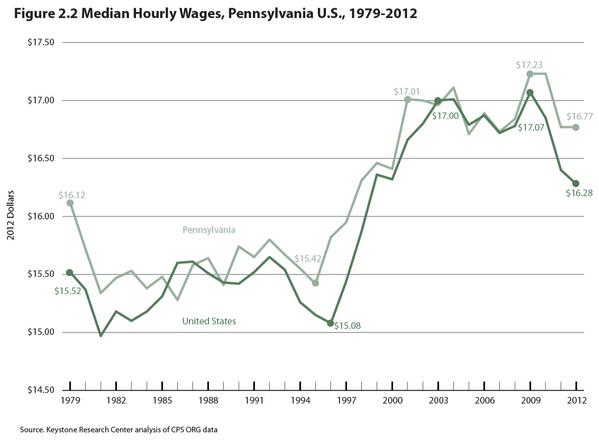
The Keystone Research Center is a great resource for economic data on Pennsylvania.  They have come out with a report on the state of wages in PA.  Above is a graph from their report showing how wages have declined since the recession began in 2009 and a map from them showing where unemployment remains the highest in the state.    You can read their full report and listen to a podcast about it at the link below.  The impact of UMPC on wages is even discussed.

State of Working PA: Slowing Job Growth, Falling Wages Impede Recovery

The drop in median wages since 2009 is not as large in PA as the US as a whole is not necessarily cause for celebration.  The rate of uninsured in Pennsylvania has also been historically lower than the nation's.  The median wage is the wage that would be placed right in the middle when all the wages of all citizens are ranked from highest to lowest.  The Census Bureau has come out with the newest Small Area Health Insurance Estimates for the year 2011.  The state rate has declined from 12.1% in 2010 to 12.0% in 2011 (the change is within the margin of error of +/- 0.2% so it's really no change).  I will be doing future posts on the county level estimates and seeing how they correlate with other county level variables such as unemployment.  

The small to nonexistent statewide drop is troubling as certain parts of the Affordable Care Act (aka Obamacare) have taken effect such as parents being able to keep their kids on their insurance until age 26.  Once the individual mandate (the least popular part of the Act) takes effect on Jan 1, 2014, wage decline could have a serious confounding effect on purchasing insurance and keeping up with co payments.  This is especially exacerbated since Gov. Corbett has refused to expand Medicaid.

**Related Posts**


Economic Impact Study Press Release


National, State, & County Uninsured Estimates


CBS This Morning Report on UPMC


Pennsylvania's New Fiscal Year Without Expanded Medicaid

Wednesday, August 21, 2013

Another Shoe Drops

We will place a limit on how much you can be charged for out-of-pocket expenses, because in the United States of America, no one should go broke because they get sick.
                                                                           Barack Obama (2009)

One of the most important consumer protections used to sell the Affordable Care Act was the annual limit on the out-of-pocket health care costs that insurance companies were allowed to charge consumers. The ACA states that, beginning in 2014, insurers cannot ask clients to pay more that $6,350 annually per individual, or $12,700 per family, in health care expenses—a sum of money that is already well beyond the means of many American families.

Now, after postponing the employer mandate—but not the individual mandate—the Obama administration has quietly postponed the cap on out-of-pocket costs as well. This was done without any public announcement. Instead, they changed the Department of Labor website's “FAQs about Implementation of the Affordable Care Act (Part XII).” Apparently the change was made in February, but went unnoticed until it recently came to the attention of New York Times health reporter Robert Pear. So far, it has remained under the radar of most of the mainstream media, but Republicans will undoubtedly make it a 2014 campaign issue.

What this means is that, at least through 2014:
  • Insurance policies that currently have no limits on out-of-pocket health care costs may continue not to have any limits.
  • Policies which have separate out-of-pocket limits for different components of coverage, i.e., separate limits for hospital costs and prescriptions drugs, may continue to apply these separate limits even though they total more than $6,350 per individual and $12,700 per family.
The people who will be hit hardest by this change are people with disabilities or chronic medical conditions, who will no doubt continue to go bankrupt at the current rate.

The reason given for this postponement is almost absurd in its cynicism. More than three years after the ACA was signed, we are asked to believe that insurers “need more time to comply” with the law because some of them “have separate computer systems that cannot communicate with one another.” (I would guess that insurance companies could reset their computers in three weeks if there were money to be made by doing so.)

The Times quotes an unnamed administration official as saying, “We had to balance the interests of consumers with the concerns of health plan sponsors and carriers, . . .” But it's hard to see much balance in these two recent changes to the ACA. Rather, they are best described by the title of a July 2 blog by Obama advisor Valerie Jarrett: “We're Listening to Businesses About the Health Care Law.” Once again, the interests of Americans suffering from serious health problems are subordinated to American corporations' insatiable drive to maximize profits.

You may also be interested in reading:

Sunday, June 2, 2013

Bending the Health Care Cost Curve

On One Hand . . .

A Friday report from the Medicare Board of Trustees shows that there was a slowdown in the growth of Medicare costs in 2012. The Medicare trust fund is now projected to last until 2026, two years longer than previously estimated. Medicare spending is now growing at the historically low rate of 1.7% per year. Of course, a decline in the rate of growth doesn't mean the problem is solved. Costs are still going up. But at least they are heading in the right direction. The report attributes the decline in costs to a combination of the current recession, which is causing people to cut back on health care, and the Affordable Care Act (ACA).

Dr. Ezekiel Emanuel, one of the authors of the ACA, points out that there are two types of cost control embedded in the ACA, payment reductions and what he calls “structural and incentive changes.” The two primary payment reductions affecting Medicare are:
  • Reduced payments for Medicare Advantage. Medicare Advantage allows seniors to purchase private insurance in lieu of traditional Medicare. It costs the government 14% more than Medicare even though it doesn't produce any better outcomes. That 14% is presumably being pocketed by the private insurance companies, and the government is taking it back.
  • Reduced payments to Medicare providers, i.e., hospitals, home care agencies, etc. Emanuel says these organizations have profited from increased productivity in recent decades, but have not passed these savings on to the consumer. Therefore, Medicare is paying them less.
In short, the ACA made $716 million in automatic cuts to the Medicare program in 2012.  This chart shows that these two payment reductions account for the bulk of these Medicare cuts. They are the primary reason for the slowdown in the growth of Medicare spending.


The structural and incentive changes include things like bundled payments, where Medicare pays a fixed rate for an episode of care rather than fee-for-service, and Medicare's Independent Payment Advisory Board, which can make specific treatment recommendations in order to reduce excess cost growth. Most of these changes are several years away.

These cost controls are an important positive changes, since they have reduced costs without eliminating benefits to Medicare recipients. However, they're only a fraction of the amount that could be saved if the country were to move to a single payer system. First of all, they only affect Medicare, which insures 17% of Americans. Secondly, they are relatively modest cuts when you consider the excess profits currently being taken by hospitals and insurance companies.

The bottom line is that these data seem to show that the ACA is working in controlling Medicare costs, but it is only a modest first step compared to what we could and should be doing.

On the Other Hand . . .

Elisabeth Rosenthal has a long article in the Sunday New York Times about the high cost of medical care in the U. S., similar to the February Time feature by Steven Brill. Her article focuses on colonoscopies, presumably because it is a vivid metaphor for what the for-profit health care system is doing to all of us. However, her chart shows several common medical costs in which the average U. S. price tag is as much as 25 times higher than the price in other countries.

The sub-heading of the article says, “Colonoscopies explain why U. S. leads the world in health expenditures,” but they do no such thing. Merely listing the costs of medical procedures does not explain why those costs are so much higher in this country. Most of Rosenthal's argument is a tautology: Prices are high because prices are high. The closest she comes to offering an explanation is buried in the nineteenth paragraph:

A major factor behind the high costs is that the United States, unique among industrialized nations, does not generally regulate or intervene in medical pricing, aside from setting payment rates for Medicare and Medicaid, the government programs for older people and the poor. Many other countries deliver health care on a private fee-for-service basis, as does much of the American health care system, but they set rates as if health care were a public utility or negotiate fees with providers and insurers nationwide, for example.

Of course, she manages to make this point without mentioning the poisonous words “single payer,” which all the other countries cited in her article have. But the Medicare data show us what could happen if the government were to take a more active role in combating greed in the health care system.

You may also be interested in reading:

Tuesday, May 21, 2013

Wall Street Journal Report on Employers Eying Bare Bones Health Plans Under the Affordable Care Act

The Wall Street Journal has a report on how employers are looking at bare bones insurance plans to control costs  (subscription needed to read online) that they are required to provide under the Affordable Care Act (aka Obamacare).  This comes as little surprise to Single Payer advocates who know that a nonprofit healthcare system is most efficient at providing care and controlling costs as our economic impact study shows.  Canadian Ellen Page eloquently defends her country's healthcare system against right wing critics below.  This is our 150th post.


**Related Posts**

New Time Magazine Article on Healthcare Costs with Stewart Discussion
Real Reasons for High Medical Costs

Those Rapacious Health Insurers Raise Premiums 9% This Year for Job Based Health Insurance

An Explanation of Washington Post Graphs on the Cost of Procedures

Wednesday, May 15, 2013

Saturday Meeting and Brill Article Follow-Up


In a follow up to Jon Stewart's extended interview with Steven Brill of Time Magazine on health care costs, Stewart did this one on other media following up on Brill's piece.   HealthCare for All PA has an economic impact study which projects that a single payer system could save the state about $17 billion per year.  Past Pennsylvania Public Health Association President Walter Tsou discusses the study at length below.

This Saturday the SW PA chapter will have a meeting to discuss how to promote the study and the Single Payer bill (SB 400) this Saturday, May 18 at 10 AM.  It will be at the Murray Ave office.  See the Contact Healthcare for All PA/PUSH tab above for directions.


**Related Posts**

New Time Magazine Article on Healthcare Costs with Stewart Discussion
Real Reasons for High Medical Costs

Those Rapacious Health Insurers Raise Premiums 9% This Year for Job Based Health Insurance

An Explanation of Washington Post Graphs on the Cost of Procedures