Showing posts with label UPMC. Show all posts

Tuesday, February 18, 2014

Hundreds of UPMC Altoona RNs Strike for Patient Care and Job Standards (Press Release from Molly Rush)


PUSH founder Molly Rush has issued a press release discussing the plight of UPMC workers in Altoona. 


In February, Altoona Nurses took to the streets of Altoona and Pittsburgh by the hundreds—braving snow and freezing temps--to send UPMC a strong message: Patients before Profits!

Six months ago—after acquiring Altoona Regional Health System and becoming Blair County’s largest employer---UPMC promised a standard of excellence for Altoona patients, nurses and the community.[1]  Six months later, however, the story has changed.

During contract negotiations with unionized Altoona nurses, UPMC has pushed for a range of changes that would lower the quality of jobs, limit nurses right to advocate for adequate staffing and quality patient care, and refused the Union’s proposed training and partnership with management to help improve patient outcomes.

On Febuary 1st   UPMC walked away from negotiations, despite nurses’ commitment to continue discussions, so 800 nurses voted for a one-day unfair labor practice strike. [2]

And on Tuesday, February 11, hundreds of the Registered Nurses of UPMC Altoona took to the picket lines to advocate for good jobs and quality care for the Altoona community.[3] The sense of solidarity on the picket line was palpable. The nurses' determination was fueled by the continual flow of cars honking their support, and the generous deliveries of food and coffee by local businesses. They marched and chanted through the snow until it was time for a candlelight vigil, to mark the seriousness of their protest.[4]

However when the nurses returned to work the next day—after 90% had participated in the one-day unfair labor practice strike the day prior—many were turned away.  Instead, UPMC is spending millions on expensive out-of-state temporary nurses. [5]

“UPMC says it does not have the resources to maintain our current contract, yet they can needlessly waste millions on temps,” said Paulla Stellabotte, RN.  “This clearly demonstrates UPMC’s misplaced priorities—wasting money rather than investing in the future of healthcare for our community.”[6]

But rather than take this lying down, and after 2 days of picketing in bitter cold, more than 100 nurses from UPMC’s Altoona hospital and their supporters[7] came to Pittsburgh to bring their concerns about staffing, benefits and patient care straight to “the boss” at UPMC corporate headquarters on Thursday, February 13th.  They roared down Grant Street with chants and pickets flying, making sure that Jeffery Romoff got the message loud and clear: Patients before Profits!


[1] Press Release, Feb 11 “Hundreds of UPMC Altoona RNs Begin One Day Unfair Labor Practice Strike…” (File Name: Press Release- STRIKE)
[2] Press Release, Feb 11 “Hundreds of UPMC Altoona RNs Begin One Day Unfair Labor Practice Strike…” (File Name: Press Release- STRIKE)
[3] Press Release, Feb 11 “Hundreds of UPMC Altoona RNs Begin One Day Unfair Labor Practice Strike…” (File Name: Press Release- STRIKE)
[4] Description from Karma Lord, who was present
[5] Press Release, Feb 12 “Registered Nurses at UPMC Altoona Return ….” (File name: Lockout Press Release)
[6] Press Release, Feb 12 “Registered Nurses at UPMC Altoona Return ….” (File name: Lockout Press Release)
[7] Press Release, Feb 13, “100+ Striking Nurses...”(File name: Press Release Altoona RN in Pittsburgh)

**Related Posts**


State of Working PA: Slowing Job Growth, Falling Wages Impede Recovery (and The Drop in Uninsured)


CBS This Morning Report on UPMC


Unbelievable Promises Monopolized Care—UPMC

Tuesday, October 29, 2013

UPMC Gives Pittsburgh the One-Finger Salute--Twice

UPMC, the largest member of Pittsburgh's health care oligopolywhose fees are well above the national average, was in the news twice last week. The City of Pittsburgh is suing UPMC, which claims to be a non-profit, to strip it of its tax-exempt status. In a court hearing last week, UPMC claimed it does not owe any payroll taxes because it does not have any employees! (Although their website claims they have 55,000 employees, UPMC says these people are employed by subsidiaries.) So far, Judge R. Stanton Wettick, Jr., has not ruled on the credibility of this claim.

The Bombardier BD-700-1A10 Global Express
On Friday, it was learned that UPMC is spending $51 million on a new corporate jet plane, a Bombardier Global Express, described as “a luxury, ultra-long range business jet with twin Rolls Royce engines.” For security reasons, the flight plans of this airplane are to remain hidden from the public.

I'm sure Pittsburghers who are struggling to pay their medical bills will be thrilled to hear that UPMC is able to afford $51 million for a new stealth jetliner. But who is going to ride around on this luxury aircraft, since, as we now know, UPMC has no employees?

You may also be interested in reading:


Thursday, August 29, 2013

State of Working PA: Slowing Job Growth, Falling Wages Impede Recovery (and The Drop in Uninsured)


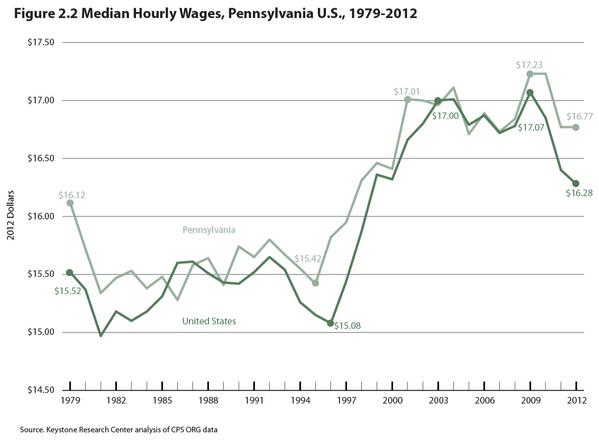
The Keystone Research Center is a great resource for economic data on Pennsylvania.  They have come out with a report on the state of wages in PA.  Above is a graph from their report showing how wages have declined since the recession began in 2009 and a map from them showing where unemployment remains the highest in the state.    You can read their full report and listen to a podcast about it at the link below.  The impact of UMPC on wages is even discussed.

State of Working PA: Slowing Job Growth, Falling Wages Impede Recovery

The drop in median wages since 2009 is not as large in PA as the US as a whole is not necessarily cause for celebration.  The rate of uninsured in Pennsylvania has also been historically lower than the nation's.  The median wage is the wage that would be placed right in the middle when all the wages of all citizens are ranked from highest to lowest.  The Census Bureau has come out with the newest Small Area Health Insurance Estimates for the year 2011.  The state rate has declined from 12.1% in 2010 to 12.0% in 2011 (the change is within the margin of error of +/- 0.2% so it's really no change).  I will be doing future posts on the county level estimates and seeing how they correlate with other county level variables such as unemployment.  

The small to nonexistent statewide drop is troubling as certain parts of the Affordable Care Act (aka Obamacare) have taken effect such as parents being able to keep their kids on their insurance until age 26.  Once the individual mandate (the least popular part of the Act) takes effect on Jan 1, 2014, wage decline could have a serious confounding effect on purchasing insurance and keeping up with co payments.  This is especially exacerbated since Gov. Corbett has refused to expand Medicaid.

**Related Posts**


Economic Impact Study Press Release


National, State, & County Uninsured Estimates


CBS This Morning Report on UPMC


Pennsylvania's New Fiscal Year Without Expanded Medicaid

Thursday, October 18, 2012

Special Screening of Tony Buba Documentary on Braddock Hospital Closing


We Are Alive Trailer from Tony Buba on Vimeo.

On November 9 there will be a special screening of Tony Buba's new documentary "We are Alive! The Fight to Save Braddock Hospital" at the Regent Square Theater in Pittsburgh which should be part of the Three Rivers Film Festival or 3RFF.com. Showtime 7PM on a Friday.  The film should include Mike Stout singing a tribute to the people of Braddock which can be seen at the link in related posts below.  More information can be read at the link to the Post-Gazette below. 

**Update**

Tickets are $10 with a six pack of $50 available in advance from showclix.com.  Further 3 Rivers info can be read at:


Read more: http://www.post-gazette.com/stories/ae/movies/potential-oscar-contenders-among-3-rivers-film-fest-offerings-658190/#ixzz29lnkCtPj 

**Related Posts**

New Mike Stout Video on Braddock's Need for a New Community Hospital


Unbelievable Promises Monopolized Care—UPMC

Friday, October 5, 2012

Unionizing Efforts at UPMC

The many low wage workers at UPMC (University of Pittsburgh Medical Center) have been working with the Service Employees International Union or SEIU to unionize.    They now have a blog and website chronicling their efforts called Make it Our UPMC.  Below is a message from one of their leaders to our founder Molly Rush.

Dear Molly,

Everyone in Pittsburgh knows UPMC is rich, but until last week, most didn’t know just how rich.
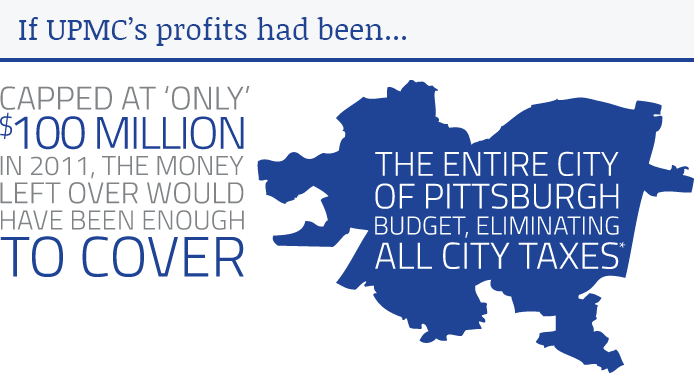
UPMC’s real estate portfolio got close examination in a series of stories in the Post-Gazette that showed UPMC now owns an estimated $2.5 billion in Allegheny County property. And because of UPMC’s charitable, “not for profit” status, it avoids paying taxes on 86% of this property taking $42 million in revenue away from our schools, cities and the County. 
It’s time we had a real discussion about making UPMC live up to its non-profit, public charity status. Join us in asking Allegheny County Council to hold a public hearing.
The series also highlighted ways in which the health system is completely unaccountable, using our healthcare dollars and tax breaks to act like a for-profit corporation. Examples abound of UPMC's willingness to pay just about any price for a desired piece of land, to distort real estate markets, and to cloak its intentions behind third party operators. One article even suggests that its new hospital in Monroeville serves more as a “giant billboard” than a real healthcare facility for members of the community.    
At a time we’re taking teachers out of classrooms and cutting transit service to the bone, can we really afford to subsidize UPMC’s land buying binges?
UPMC’s questionable behavior isn’t just limited to its real estate transactions. Despite making $351 million in operating profits last year and holding $4 billion in reserves , many UPMC employees live in poverty and earn less than a family-sustaining wage. 
It’s time for our largest landowner and “charity” to start acting with OUR interests in mind. We need Allegheny County Council to investigate UPMC’s actions. Sign this petition calling for a public hearing.
With your help we can Make It Our UPMC.
Sincerely,
Rev. David Thornton

Sunday, September 23, 2012

New Mike Stout Video on Braddock's Need for a New Community Hospital


I received this new video that was put together by Tony Buba of Braddock Films on the need for a new community hospital in Braddock, PA.  Mike Stout who sings the tribute to Braddock Hospital will also be performing on October 7 at the Frick Fine Arts Center at 7:30 with the Human Union Band.  Details can be seen at the Facebook page here.  Buba is also raising money for a documentary profiling the damage done by Braddock Hospital being closed by UPMC called the Kickstarter Campaign.  Info is below.


**Related Posts** 


Unbelievable Promises Monopolized Care—UPMC


Mike Stout & the Human Union Band Concert

Monday, March 12, 2012

Unbelievable Promises Monopolized Care—UPMC


It took UPMC only three months to close a community based hospital that had been in operation for over 100 years.  In 1996, when UPMC purchased Braddock Hospital, did the residents of Braddock have any idea of the demise that would follow?
Braddock, a struggling post steel mill community composed of elderly, low income, and African American residents, utilized the community hospital not only as a source of health care but as a community center. Braddock Hospital, the newest building in the community, also served as a place to get a hot meal in the cafeteria and had the town's only ATM.  It also was the community’s largest employer. The building was slated for demolition in order to build shops and restaurants.
UPMC, a non-profit organization, promises in its mission statement to provide health care to those in need, not to refer them to a bus schedule to travel to a sister hospital.
UPMC (Unbelievable Promises, Monopolized Care) continues to dictate health care while providing million dollar bonuses to their CEO and administrators. They do this by purchasing  facilities only to close them, building multi-million dollar facilities near other non-UPMC facilities, purchasing physician practices, and providing care based on the type of insurance the patient carries.
Decreased census and increased operating expenses have been cited as reasons for the closure of Braddock Hospital. But, if you close the obstetric and oncology units your census will certainly decrease. They also did not include the number of admissions to behavioral health, alcohol, and drug detoxification beds. Braddock was said to have a 69% occupancy rate, which was above standards. Former employees and patients stated they were directed to transfer patients to another UPMC facility regardless of the need.
Traveling to another UPMC facility is not always feasible for the elderly, or those on a fixed income with no means of transportation except for public transportation. If one is sick enough to go to the hospital or emergency room because of an injury or bleeding should they have to wait on the street corner for a bus and make transfers before reaching the hospital. Not every hospital visit necessitates an ambulance and many cannot afford to pay for an ambulance for non-life threatening situations. Would an UPMC official have his family take numerous buses to the hospital? These people probably have physicians waiting for them and their own private rooms.
Despite public outcry and lawsuits the residents of Braddock have received little conciliation. They did receive minimal satisfaction in a civil rights injunction; an agreement was reached that provided van service to doctor's offices in the area for an additional three years. But they still have no local facility to receive health care.
Yes, healthcare has become a business where the elite profit (like the steel mills before their closure and UPMC) and those in need continue to be the victims of circumstance (like the community of Braddock).

Tuesday, February 14, 2012

Occupy Healthcare Rally/Progress PA Recap


On Sat Feb 11, dozens braved the bitter cold to protest near the fenced off Occupy Pittsburgh encampment.  We marched from UPMC to Highmark headquarters.  Julie Sokolow has a good video summary of the event.  Duquesne student Trenita Finney has an upcoming post on her experience of the rally.

At the same time the PA progressive summit was going on in Philadelphia.  Jerry Policoff of the statewide organization gave a talk on statewide efforts to enact single payer.  His presentation can be seen below.
Walking back to my car afterward I met a man named Joe Vodvarka in the Strip District who was collecting signatures to get on the ballot for a Senate bid to challenge Bob Casey in the April 24 primary.  He said his main reason for doing so was to oppose Casey's support for trade deals with China.  I asked him what his position on single payer was and he gave me a vague answer that he supported health insurance for everyone which told me he didn't understand the question.  I suggested to him that he learn more about single payer and gave him a handout from the rally.  His webpage on the issue sounded like he's dissatisfied with 'Obamacare" but he needs to be informed that there is a better alternative.  Mr. Vodvarka is typical of many small businesspeople who may not realize that a single payer system could save their business a lot on health care costs. Below is his campaign video.


Calls to his office to discuss single payer were not returned.  His focus on trade with China runs the risk of having his campaign portrayed as 2010 Tennessee Gubernatorial candidate Basil Marceaux.
 
The Colbert ReportMon - Thurs 11:30pm / 10:30c
Republican Gubernatorial Primary Battle Watch '010 - Tennessee
www.colbertnation.com
Colbert Report Full EpisodesPolitical Humor & Satire BlogVideo Archive
**Related Posts** 

STOP Obamacare in Pennsylvania: Where We Agree with Them 


Gekkonomics


Santorum: No One Has Ever Died Because They Didn’t Have Health Care | The New Civil Rights Movement


Friday, January 13, 2012

Gekkonomics

You won't be surprised to learn that the University of Pittsburgh Medical Center's (UPMC) out-of-network fees are way above the national average. According to data compiled by the Center for Medicare and Medicaid Services, UPMC charges more than many of the nation's most highly regarded hospitals, such as the Cleveland Clinic, and twice as much as its only real competitor, Allegheny General Hospital (AGH). In 2010, UPMC's average charge for inpatient care was $121,765, compared to $74,406 at the Cleveland Clinic and $55,205 at AGH.

Out-of-network fees originated in the 1980s, when Medicare and Medicaid began reimbursing hospitals prospectively rather than after-the-fact for some procedures. Insurance companies then began to negotiate discounts for their subscribers, in exchange for channeling those subscribers to “approved” doctors and hospitals. By 1990, only people without health insurance and international visitors were charged the “full cost” of medical services—the out-of-network rate. For people with health insurance, the “full cost” is really just funny money—an unrealistically high charge that appears on their statement. Health insurance pays only a fraction of that cost, and the remainder is waived.

However, in June 2013, out-of-network fees may become real money for many Western Pennsylvanians if UPMC, the region's largest hospital chain, carries out its threat not to negotiate an agreement with Highmark, the region's largest health insurance company.

If we accept the Medicare reimbursement rate as the real cost of hospitalization plus a modest profit for the provider, then UPMC has an average markup of 850%. Dr. Gerald Anderson, a health policy expert at Johns Hopkins University, is quoted as saying, “I think they have an ethical problem in trying to say they should be paid eight times more than what it costs to provide the service.”

This brings us to the presumed motive for UPMC's and Highmark's behavior—monopoly control and the ability to fix prices. Large corporations move toward monopolies through two types of integration, horizontal and vertical.

Horizontal integration occurs when companies buy out competitors that provide the same product or service, thereby increasing their market share. For the last decade, UPMC has been aggressively buying other hospitals in the region. AGH is its only major remaining competitor. If it provides an essential service and has no competitors, it can charge whatever it wants.

Vertical integration occurs when a company controls several stages in the supply chain that produces a product or service. For example, a company that sells natural gas to consumers may also own gas wells and control prices by speeding up or slowing down production. Or a movie studio may own a theatre chain which preferentially books its films and refuses to book films by competitors. In 1998, UPMC started its own health insurance division, the UPMC Health Plan. Highmark retaliated by agreeing to purchase AGH. Of course, both hospitals and insurance companies can use the threat of out-of-network fees to pressure clients to purchase the complementary service from its own affiliate.

It appears that both UPMC and Highmark are trying to obtain monopoly control of the health care system in Western Pennsylvania. Since our very lives are at stake, if either of these “nonprofits” achieves their goal, they will be in a position to make us what organized crime calls “an offer we can't refuse.”

Of course, this kind of outrageous profit-taking would disappear under a single payer health care system.