Friday, May 25, 2012

Pearl Korn: With the Affordable Care Act Hanging by a Thread, It's Time for Single-Payer

Pearl Korn has written another guest post on the possible impact of the upcoming Supreme Court decision on the Affordable Care Act which first appeared in the Huffington Post on May 21, 2012 and is reprinted here.

Co-written by Jonathan Stone
While the Affordable Care Act is being deliberated in the Supreme Court -- with no decision expected until the end of June -- progressives and all other rational human beings should ramp up their efforts to build the movement for single-payer and work to ignite the Occupy movement on this issue. The Occupiers are expected to become more visible at the beginning of July, and they could and should become a single-payer force. They could even join the loud chorus coming from the GOP to overturn the ACA and its mandate. Finally, something on which the left and right can at long last agree -- for very different reasons, of course.

The right wants to privatize health care, while the left wants a real national health plan as exemplified by a single-payer model. To date, we have still not seen a coherent health care proposal emerge from the right, while the left has been less than visible in voicing their distaste for the ACA. Too many Dems and so-called progressives in and out of Congress -- including unions -- have flaked out and publicly supported the ACA, while privately loathing it. It is the nature of politics to accept and vote for half measures and Band-Aid solutions to accomplish "something rather than nothing." Standing one's ground on principle is a foreign concept. Where are those 590 local union organizations, including 140 Central Labor Councils and Labor Federations and 40 State AFL/CIO's on this issue? All of them support single-payer and Rep. John Conyers' H.R. 676 bill, The United States National Health Care Act. The unions keep signing on in support of this bill, but have they taken their numbers to congressional leaders or the White House? Are they rallying in the streets? Obviously not.

A huge opportunity was lost when President Obama took office almost four years ago and all three houses were controlled by the Dems. Yet the silence from the unions even then was deafening. With nothing drawing them to single-payer, the Obama administration kept it off the table in its ill-timed health care debate. Our president said in those early days that if he was "starting from scratch," he would go to single-payer. Where was the will to do the right thing? Instead, the insurance industry was allowed to write the legislation, using Mitt Romney's Massachusetts health care plan as a template, which he created with the aid of the Heritage Foundation. As a result, they gave us a system that increases health insurers' control over people's health care decisions and will deliver some 31 million new customers into a system that is rotten at its core and does not essentially change how health care is delivered or paid for. The money continues to flow to the insurers, while delivering less in services each year and shifting more costs to the insured. People are downsizing their use of health care due the unmerciful costs, which remain un-contained. It is not hard to imagine the long-term effects of delayed or ignored health care. We see it every day in hospitals across the country.

Even corporations that have provided health insurance to workers for decades are scrambling to get out of the insurance game, so fewer and fewer have insurance on the job, which has kept untold numbers locked in jobs for decades they would prefer to leave. I'm sure they would bolt in a heartbeat if a comprehensive health care plan such as single-payer were helping not only to give them freedom of choice in the job market, but also bolstering the economy. The core of the ACA is to offer subsidies or Medicaid, which is costly and unsustainable. Corporations have every incentive to end on-the-job insurance and let employees fend for themselves, a truly GOP philosophy. We are the only industrialized nation that hinges health care to the job. It makes no sense now, but it did make sense during World War II, when labor was scarce and a great enticement was needed to bring those remaining at home into the factories. Health care coverage was the hook.

Now we wait for this activist Supreme Court to render its decision and put its stamp on health care policy for years to come. It will either let the ACA survive in bits and pieces, or find it unconstitutional as a whole and throw it out. While the right has yet to unveil an alternative plan, neither does the Obama administration have a "Plan B," as it is certain it will prevail and the bill will be found constitutional -- a foolish stance with the Roberts court in control.

If the GOP and so-called conservatives are sincere about cutting costs, fraud and waste in health care, they should embrace single-payer. After all, it would cut $400 billion yearly from health care costs, money that could certainly cover all Americans and be used for other national needs, other than further military buildups. Imagine the efficiency of rolling Medicare and Medicaid into one system of Improved and Expanded Medicare For All, all while operating at greatly reduced cost. The structure is already in place, with the current administrative cost of Medicare at a modest 3 to 4 percent. Better health care and lower costs -- what a revolutionary concept. Not to mention that single-payer would put an end to those 50 percent of bankruptcies that occur due to illness and medical bills. A healthier, more solvent middle class would emerge.

If the ACA is thrown out, President Obama should breathe a sigh of relief and finally push for single-payer. He would be vindicated and have a real opening, and the American people would support him and his bold new stance. Our president would be in his final term and free to finally deliver on that "change" he promised so long ago.

Right now, single-payer advocates are working in several states to institute single-payer programs. Even New York Assembly Chair of Health Dick Gottfried recently introduced his resurrected single-payer bill, which he first put forth in the early 1990s. Ever the politician, he feels there is a growing movement and support for such a bill right now and wants to get in on the action. Indeed, the single-payer movement as a whole must grow and become much more cohesive and effective if it is to play a role in reshaping the health care debate if the ACA is found unconstitutional. We all know that the first group to be thrown under the bus in any "compromise" legislation drafted to replace the ACA would be those folks with pre-existing conditions. Even within the ACA itself are cuts that will allow our government to essentially turn its back on the most vulnerable among us, like the little item of cutting $4.9 trillion from Medicare part A and B between 2014 and 2033.

There has to be -- and is -- a better way, and every effort must be made to continue to build the Single Payer movement, regardless of the outcome in the Supreme Court, for it is the only rational solution to our many national economic woes. Now, the single-payer movement must ramp up its efforts and become much bolder in its demand for a truly comprehensive national health plan. The American people have waited long enough.

Wednesday, May 23, 2012

New Interactive Map on County Poverty Rates

Slate.com has produced an interactive map showing how poverty rates have changed in each US county from 2007 to 2010 to show the impact of the recession.  Only Bradford County in the northeast has shown a significant decrease for Pennsylvania from 14% in 2007 to 10.9% in 2010.  The other 66 counties in PA either increased or stayed the same.  Crawford County had the largest increase for PA from 14.1% to 19.7% with the other largest increases in the western border counties Mercer and Beaver

You can see the profile for Pennsylvania by placing the arrow over PA on the map, dragging it to the center, and enlarging it by clicking on the plus sign in the upper left hand corner.  By moving the arrow over each county you will see a window with the name of it on the right and the poverty trend from 2007 to 2010.

**Related Posts**

County Health Rankings


Correlating PA County % Uninsured Rates with Other County Level Measures


Overall Health System Performance - The Commonwealth Fund


Monday, May 21, 2012

Lessons from HBO's 'Weight of the Nation'


This past week HBO debuted a four part documentary called The Weight of the Nation on the obesity epidemic in the US.  The clip above from part four talks about how geography can have a big effect on one's health due to the socioeconomic factors which surround these areas.  The fourth episode which deals with public health challenges can be seen below and is relevant to much of the research I have been doing for PUSH-Healthcare for All PA on Pennsylvania's uninsured.  The episode can be seen below.  All four parts can be seen at the above link in italics.  I'll review this episode in particular.


The program does a good job of presenting the data and issues related to the obesity epidemic in the US.  The impacts of their actions, intentional or not, are discussed at length including those on health care costs.  Various solutions to the problem are discussed such as ending farm subsidies, creating more park space in inner city areas such as Philadelphia County, and adding more bike trails.  While all of these are good things which I fully support, how much does the obesity epidemic really contribute to the high cost of health?  According to The Incidental Economist only around $25 billion in extra health care spending in 2004 can be attributed to health problems related to obesity because other non obesity related diseases such as prostate cancer are just as prevalent in the US relative to other countries with universal care such as Japan, Germany and the UK as can be seen in the graph below.  Diseases below the horizontal line in the graph such as Hepatitis B and Bladder Cancer are more prevalent in those countries.  You can see more cost analysis at this page.

In the opening credits of the episode above we can see that one of the sponsors of this documentary is Kaiser Permanente which was skewered for its profiteering practices in the film Sicko by Michael Moore.  The practices of the health insurance, pharmaceutical, and agribusiness industries to maximize profits often overlap.  I credit the filmmakers for skewering the food industry.  Is the Kaiser Permanente using this documentary to distract individuals from their own practices?  Congress only turned on the tobacco industry when the costs to the health care system became clear.

**Related Posts**

Evergreening


Moving Backward 


Unbelievable Promises Monopolized Care—UPMC


WaPo Interactive International Cost Graphic

Friday, May 18, 2012

Those Rapacious Health Insurers Raise Premiums 9% This Year for Job Based Health Insurance

This is a guest post that originally appeared in the Huffington Post by Pearl Korn from Oct 5, 2011.  This is reprinted with her permission.
 
Last Tuesday the Kaiser Family Foundation, a highly respected nonprofit health research organization, released its annual health insurance survey based on its research of some 2,100 small and large firms. Kaiser reported a whopping 9% rise in premiums this year for family plans and an 8% increase for single plans. These increases do not reflect additional out-of-pocket costs workers pay for healthcare, such as co-pays, deductibles and prescriptions. These plans cover some 150 million in the work force.
Closer scrutiny of these numbers is required to clearly see and understand how the model of job-based insurance is becoming a serious and eroding issue to Americans economically. Kaiser documents that in the past decade, workers' wages rose 34%, while inflation increased 27%. However, in 2011 earnings rose 2% while inflation rose 3%. Job-based healthcare plans now cost a whopping $15,000 per year for a family, with workers picking up $4,129 of that amount, meaning that workers' share of healthcare costs has risen a stunning 131% in 10 years. The cost for a single employee plan comes in at $5,429, with the workers' share rising an even more shocking 159% during the decade. Add to this increasingly unbearable burden the fact that 31% of covered workers are now in high-deductible plans, which can range from $1,000 and up. One should note that the bulk of the costs in these plans are paid by employers, for which they receive tax breaks. This story made the front page of the New York Times last Wednesday as the details of Kaiser's report were rolling out, and also hit The News Hour on PBS as well as McClatchy Newspapers. Even Nancy-Ann DeParle, Deputy Chief of Staff for Policy in the White House, weighed in on this issue, particularly as it related to insurers profits.
Barclays Capital reported that 13 of the 14 top health insurers beat their projected earnings in the last quarter, with profits coming in at hefty 46% higher than expectations. Insurance CEO's must be living large with their booming industry, one of the few growing sectors in this stagnant economy. This 9% increase in premiums is the highest since 2005, and comes on top of a 3% rise in healthcare costs in 2010. Speculation is plentiful. Will costs continue to rise, or drop as they had in the preceding few years? Is the recession a factor? And has this increase come in anticipation of more of the Affordable Care Act kicking in next year? After all, these increased rates were set last year, so they would be more proactive than reactive to the current situation. These increases in co-pays, premiums and deductibles makes the current health care model an unattractive and faulty product that encourages lack of use, with more of the costs increasingly shifted to the workers, two factors that would play a significant role in increased insurer profits.
Another discouraging ploy to limit healthcare use is the growing trend toward tax-preferred health savings accounts, with money regularly placed in accounts to be used for medical needs. This appeals to the young, who believe they will never become ill or in need. The money keeps growing, which in itself is an attraction to keep on saving and not use healthcare services, delaying needed healthcare that can only lead to deeper crises down the road, when serious, more complex illness sets in and the system becomes overwhelmed. What then?
The health insurance costs for those in the individual and small business markets are even worse. One insurer last year in California sought a 38% increase in premiums for individual policyholders, outraging the nation. If we factor in the acknowledged 50 million with out health insurance, and add in those 23 million unemployed and underemployed, we have a serious problem. We have an unsustainable, fractured healthcare system that, simply put, does not work for anyone except the insurers and drug industry.
Of course, one would think that corporations would also get that they should not be in the business of providing healthcare, at least if that is not already their primary function. Are we not the only industrialized nation that places such a tremendous responsibility and burden on corporations? They should be unburdening themselves from the responsibility and costs by becoming major advocates and players in the growing movement pushing for an Improved and Expanded Medicare For All. Now that would be lobbying most of us could support. Corporate America would be off the hook and would only pay a reasonable tax -- along with their employees -- to provide a true National Healthcare system. As the current, patchwork, failed system continues down its current path, it is clear there is really only one makes sense solution -- a single payer system with an administrative cost currently of only around 3%. This would save our nation $400 billion annually and could provide quality healthcare to one and all at half the cost of the current system. Where are the deficit hawks on this thinking?
Just look at the single payer model of the VA, which has provided innovative, efficient and quality healthcare to our veterans, not to mention negotiating prescription drug costs directly with pharmaceutical companies. Another model would be Medicare, at least before the specter of privatization crept in. The ACA leaves prescription drug negotiating out, which also occurs in Medicare Part D plan, offering little more than tremendous gifts to the drug companies. As health plans begin to roll out and hit our mailboxes, there will be shocks aplenty. Some information I received over the weekend from my insurer clearly shows further slicing and dicing of benefits, with costs hiked significantly across the board for all services and drugs, especially those nasty, annoying co-pays. Meanwhile, insurance CEO'S are hopping, skipping and jumping all the way to the bank, with their high multi-million dollar annual salaries and perks. Take from the poor and middle class and give to the rich -- Robin Hood must be rolling in his mythical grave.
Next year, to implement any rate increase above 10% for new enrollees in plans, insurers will have to go public and justify those rate increases to state regulators. This is law in the ACA, one of the several good inclusions in the bill, and could affect those 30-odd million that would be insured under the ACA who are currently uninsured. But does that mean premium increases of 9.5% would go unchallenged? Employers will make every effort to opt out of providing health insurance to their workers, sending them off to join an ACA subsidized plan if they qualify. The costs of workers' healthcare now -- on a state and corporate level -- has produced fierce battles in many states to downsize workers benefits in union contracts. Collective bargaining was the big summer issue across the country, and will continue to be for the foreseeable future as states under GOP control continue to decimate workers' rights, especially targeting health benefits.
In the coming months, we can also look to the Supreme Court to rule on the constitutionality of ACA. Last week, the president and 26 states contacted the high court to move forward on this issue. Surely, the question of the government mandating the public to buy a commercial product will be hotly debated. All of this will play out just before the election, giving the GOP a powerful weapon to distract the public and aim at the president, which may ultimately sink his chances of being re-elected, especially if the moribund economy and jobless rate continue unabated in 2012.

-- With Jonathan Stone

Sunday, May 13, 2012

Aaron Carroll's Analysis of Single Payer and Wait Times


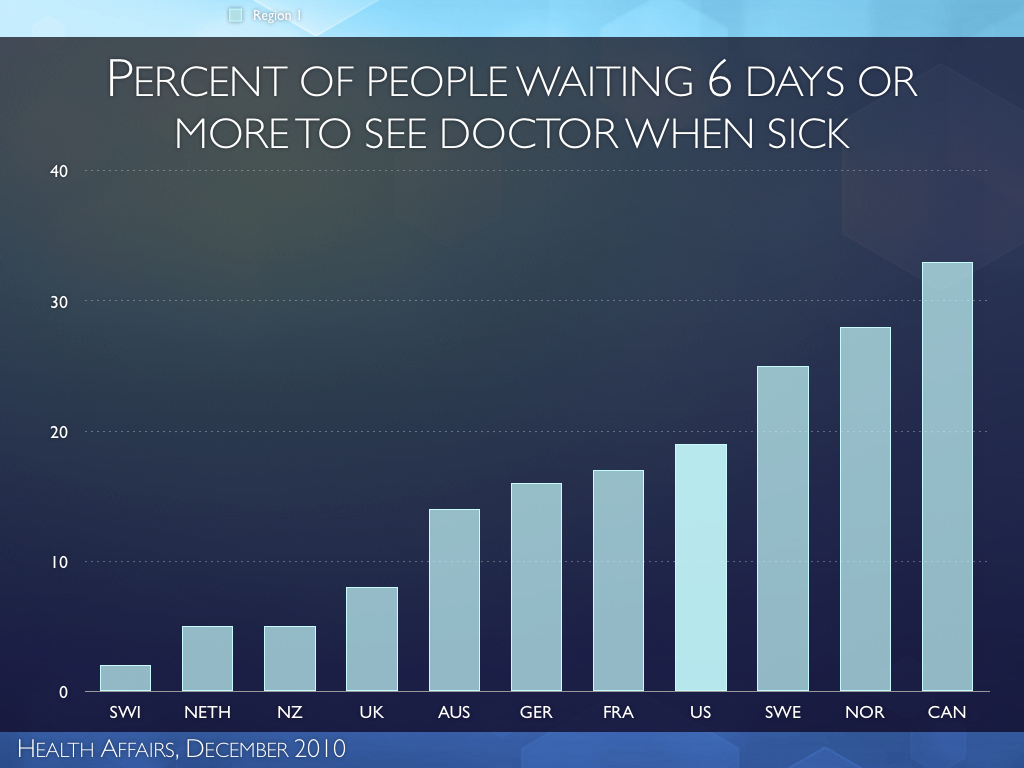
(This is a repost from my other blog.) Aaron Carroll at The Incidental Economist has a good analysis of waiting times in the US and in other countries with universal health coverage that do a far better job of controlling costs and providing care than the US.  He shows with lots of charts and graphs that the US with it's flaws in the other areas is still not the best when it comes to waiting times.  All when it's been shown over and over again that the US trails the developed world with single payer systems in health outcomes such as life expectancy and infant mortality.

Enough with the wait times, already – ctd. | The Incidental Economist


Enough with the wait times, already


Aaron Carroll made an appearance on The Colbert Report to discuss Single Payer healthcare.


**Update**


Dr. Carroll has been getting so many comments on his posts on wait times that he's written another titled:

The demonization of wait times


In it he talks about the real causes of wait times in health care systems, fiscal austerity.  The blog he contributes to, The Incidental Economist, has great commentary on healthcare on a variety of topics.


**Related Posts**

POLL: Dislike of healthcare law crosses party lines, 1 in 4 Dems want repeal - TheHill.com (But Doesn't Ask Why)


The US and Republicans Want Health Care Law Repealed....?


Teapartiers sandbagged by health insurers | MollyRush's Blog and a calculation mortality rates for lack of insurance.


Variability in Health Care Survey Reports but not in Vermont's Health Care Plan


Vermont single payor | The Incidental Economist


Saturday, May 5, 2012

PRIMARY INVESTIGATOR IDENTIFIED BY EIS TEAM

We are excited to report that we are close to
finalizing the selection of an organization that will conduct an
Economic Impact Study.  We hope to be able to announce the specifics
within the next few weeks.

Sunday, April 29, 2012

Evergreening

The Incidental Economist (a blog) alerted me to an article by medical student Nicholas Downing and three colleagues exposing the outrageous shenanigans of Abbott Laboratories, maker of fenofibrate, a lipid-modifying drug that claims to reduce the risk of heart disease.

In the U. S., patent protection on a new drug expires after 20 years. Since the clock starts ticking before clinical trials can begin, by the time a drug gets Food and Drug Administration (FDA) approval, it typically has seven to twelve years of patent protection. After that, other companies are free to sell generic equivalents, which usually cost less than half the price of the original. The goal of pharmaceutical houses is to extend that patent protection as long as possible by whatever means necessary.

Abbott did not do the research and development that led to fenofibrate. They bought it from another company. They marketed it as Tricor-1 in 1998. However, their patent was about to expire, and in 2000, another company, Novapharm, announced its intention to produce a generic version. Abbott then filed suit for patent infringement. This was a frivolous lawsuit, but such suits are routine because when they are filed, they automatically result in an injunction against the generic company which prevents them from marketing the generic for 30 months. Drug companies almost always lose these infringement cases, but they file them anyway because the amount of money they make during the 30 month waiting period is far greater than the cost of the lawsuit.

The 30 months also gave Abbott time to get a patent for Tricor-2 and introduce it to the market. Tricor-2 was identical to Tricor-1 except for the dosage. Because it was the same, no new clinical trials were required. By the time the 30 month period had expired, Tricor-1 was no longer available and Tricor-2 had cornered 97% of the fenofibrate market. It was useless to produce the generic version of Tricor-1 because Tricor-2 had different dosage levels, and pharmacists can only substitute generics when the dosage levels are the same.

So the generic company announced its intention to produce a generic Tricor-2. At this point, the story begins to resemble the plot of the film Groundhog Day. New lawsuit by Abbott. Another 30 month wait. Abbott announces Tricor-3. It captures 96% of the market. Generic company intends to produce generic Tricor-3. New lawsuit. Another 30 month wait. Abbott announces Filibrix. Filibrix is fenofibric acid rather than fenofibrate, which requires new clinical trials, but gets them an additional three years of patent protection extending it to 2012.

By this time, the generic companies had noticed the futility of their strategy, so they filed suit against Abbott for violation of the Sherman Antitrust Act. Abbott eventually settled that suit for $300 million, which was about 4% of what they made selling various versions of fenofibrate. The authors estimate that the cost to the public of using Abbott's versions of fenofibrate rather than their generic equivalents is $700 million a year.

This is not an isolated incident. Several other drug companies have done the same thing. When the patent is about to expire on one of their lucrative drugs, they make a trivial change and market it under a new name in order to extend their period of exclusivity. This common practice is called “evergreening.” (Get it?) It succeeds in part because doctors don't pay attention to what's going on. However, even if they had known about Abbott's psychopathic behavior, there was nothing doctors or pharmacists could do because no generic equivalent of fenofibrate has yet made it to the market.

To add insult to injury, a large outcome study published in 2005 showed that fenofibrate was ineffective in reducing the risk of cardiovascular disease. But apparently the doctors weren't paying attention to that either, because as of 2010, fenofibrate sales were still increasing.

There is a serious problem with the FDA's system of granting patents. They only require clinical trials that compare the new drug with a placebo—an inactive pill that supposedly controls for patient expectations. This allows different drug companies to market nearly identical drugs, none of which are more effective than the others. It also allows companies like Abbott to “evergreen” by relabeling old drugs under new names. A more sensible standard would be to compare the proposed new drug to the best existing treatment and only grant a patent if the new drug produces a significant improvement in patient outcomes.

In our capitalist wonderland, it's useless to urge “corporate persons” such as Abbott to behave more responsibly. They will pursue profit however they can. It's probably also unrealistic to expect doctors to read medical journals or prescribe available generics. They get their pharmaceutical information from drug salespersons bearing gifts—everything from ballpoint pens to free trips to Las Vegas (to attend a medical “seminar,” of course). It would be nice if Congress would make this legalized bribery illegal, but since they're doing the same thing, that's not likely to happen.

Downing and his colleagues only suggest one governmental remedy—elimination of the 30 month hold on the generic during a lawsuit. Otherwise, they just recommend consciousness raising among patients, doctors, and pharmacists. Good luck with that.