Tuesday, July 10, 2012

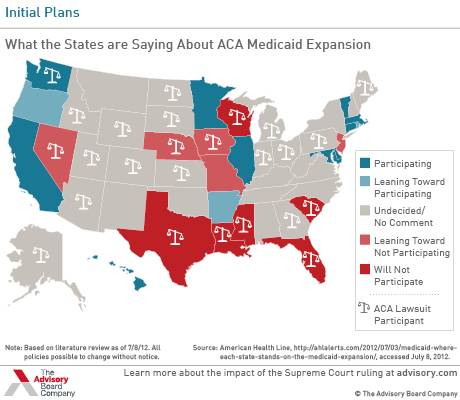
States not participating in Medicaid Expansion So Far


Texas now added itself to the five other states above in dark red which will not participate in the ACA medicaid expansion even though it leads the nation in the percent uninsured at 26.3% and is correlated most strongly with income and the % Latino population at the county level. Here is Texas Gov. Rick Perry's justification:


Pennsylvania is listed in the top graphic as undecided toward participating.  Ezra Klein believes all states will eventually sign up as they are reimbursed.  The right graphic shows four of the six states, Texas, Florida, Louisiana, and Mississippi, having having some of the highest within 200% of federal poverty (Mississippi, try living on that governors) and uninsured (Texas) rates in the US. South Carolina and Wisconsin had  19.4% and 10.6% uninsured rates and 30.9% and 20.9% 200% poverty rates in 2009 respectively.

**Related posts**


Latino Rates in Pennsylvania's Uninsured 


The Supreme Pennsylvania Medicaid Decision


Rick Perry's Efforts to Save Us All 


A Statistical Profile of the Uninsured in Washington, DC, New Mexico, and Texas

What's a Tweet? And what's all this Twitter about? : Computer Class

I am often asked to show individuals how to use Twitter, Facebook and/or Blogspot.  Podcamp provides free classes on these topics.  This can be an effective tool in supporting nonprofits as well as relationships and business.  This next Wednesday, July 18, they will be having a free class on how to use Twitter.  I recommend that all who are interested attend.

Wednesday, July 18, 2012  
6:00 PM - 8:00 PM

This mini-session of PodCamp Pittsburgh--a local annual conference about information sharing online--will introduce you to some of the most popular social networking tools. Learn why Twitter is being used in personal relationships and business. Don't have an account? We will set you up! Please feel free to bring your phone or laptop if you need help setting up and we'll walk you through.
Presented by: Michael
Event fee: Free
Sponsor: PodCamp Pittsburgh
Location:
4400 Forbes Avenue
Pittsburgh, PA 15213

Contact:
PC Center Staff
412-578-2561
pccenter@carnegielibrary.org


Registration is required for this event.
You can register by calling 412-578-2561 or by filling in the form below and clicking on the Register button.

Friday, July 6, 2012

The ONLY Answer.

This Oped piece appeared in the Erie Times.

Why Pennsylvania should opt for single-payer health system

When asked, almost all Americans will say that access to health care is of major concern to them. But access means different things to different people. For some who have chronic illnesses, it is how to pay for the continuing costs of treating the illness. That may mean paying for health care insurance and its deductibles and co-pays, or it may mean having the ability to acquire health care insurance even if cost is not an issue. For others it may mean having the ability to manage one's own health care along with their medical professionals and not having to subject themselves to the dictates of the health insurance carrier.

Those who do not have health care insurance and do not have the financial ability to pay for it must live in the constant fear of injury or illness, which would devastate their personal finances and potentially destroy the economic future of themselves and their family.

There is no question that this country has the finest medical care in the world. Our ability to identify, manage and treat injury and disease is without peer. But, all of that is valueless if one does not have access to the system. While it is true that everyone will ultimately be treated, even if they do not have health care insurance, it is not free. Someone has to absorb the cost. That normally means that doctors, hospitals, government and insurance carriers (through higher premium costs for their policy holders) all share the costs in some proportion.

In March 2010 Congress passed the Patient Protection and Affordable Care Act. This landmark legislation addressed some health care issues, but also left many questions and legal challenges. The U.S. Supreme Court has upheld the constitutionality of the act which means that the various provisions will continue to be implemented, mostly by 2014 but also continuing through the end of the decade. One provision is that states may propose their own innovations in health care, provided that those innovations do not fall below the requirements of the PPACA. As the law is written, this cannot occur until 2017.

In Pennsylvania citizens from all walks of life have banded together in an organization known as Health Care 4 All PA. We believe that resolution of the health-care issue begins with allowing the states to adopt health-care programs tailored to the needs of their residents. Moreover we believe that a single-payer system is the most cost-effective and economical method of delivering that health care. Research data and economic analysis supports that conclusion. Huge costs of the present health-care system are eliminated through reducing or eliminating extensive administrative, marketing and management costs.

Single-payer means, simply, that every Pennsylvania citizen would be provided health care with the expectation that every citizen and every business would contribute to its cost. It is clear that those costs would be significantly less in total than the costs of the current system, which leaves many Pennsylvanians without health care protection.

Our organization is committed to moving forward with a single-payer model and to be prepared to join other states including Vermont, Hawaii, Montana and Washington by 2017 with the implementation of the proposal.

Legislation has already been introduced in the Pennsylvania House (HB 1660) and Senate (SB 400). Even though PPACA is now the law of the land, it still leaves many Americans and many Pennsylvanians unprotected. Therefore, now is the time for new efforts and new ideas to ensure that all of our citizens have the comfort of knowing they will be able to utilize the best health- care system in the world when they need it.

But it will not happen until and unless the people of Pennsylvania make it happen. Learn about the single-payer option. Study the alternatives and then decide what works best for you and your family. Finally, contact your state representatives and state senators and ask them for their ideas. Remember that this is an election year. They will listen. Ask them to support and fight for the health- care solutions that will benefit every Pennsylvanian.


DAVID STEIL, of Yardley, is president of Health Care 4 All PA and owner of a manufacturing business. A Republican, his 27 years of experience in government includes serving as township planning commission, a township supervisor and in the Pennsylvania House of Representatives.
Does Propaganda Work?

First of all, before you read any further, you have to take this pop quiz on the Affordable Care Act (ACA) written by the Kaiser Family Foundation.

Finished yet? O.K., now you can read Kaiser's analysis of the results. You'll find that less than 1% of respondents got all ten items correct. I was one of them, which is why you people should listen to me when I'm talking!  ;)  You'll also find that people who got fewer correct answers were (among other things) more likely to be Republicans, watchers of Fox News, and in favor of repealing the law.

Kevin Drum has constructed the following chart. He points out that there has been more conservative disinformation regarding the five items that more people answered incorrectly than the other five. This suggests that the right wing and their media enablers have been effective in misleading the public about the ACA.


I'm not sure I buy Drum's argument, since he has no data on how frequently false claims were made. I don't recall hearing that much about the nonexistent mandate that small businesses offer coverage to their employees, for example. Of course, there have been more complaints about the individual mandate than any other provision of the ACA, but in this case, the conservatives have not lied about it. There really is an individual mandate, although they have neglected to point out how small a percentage of Americans will be affected by it.

In order to get these results, you need more than just conservative propaganda. You also need corporate news media that fail to correct it, media that present these false claims as a he-said-she-said “controversy,” without explaining who is right and who is wrong.


Update

Thanks to Paul Ricci for pointing out that paid advertisements have almost certainly been a major factor in spreading public misinformation about the ACA. On June 20, The New York Times added up the expenditures to that date.

The amount spent attacking the ACA ($235 million) was 3.4 times the amount spent defending it ($69 million). Almost all the pro-ACA ads were from the Department of Health and Human Service ($47 million)--ads which the Times describes as “bland, explaining aspects of the law.” The anti-ACA ads come largely from the usual cast of Elephants who have emerged as major players in the post-Citizens United ad wars—the U. S. Chamber of Commerce ($27 million), Karl Rove's Crossroads USA ($18 million), etc. As part of the captive audience for these ads, I would not describe them as bland. The anti-ACA ads play to people's fears about government takeovers (“socialism”), rising deficits, and the rationing of care.

The anti-ACA ads have played primarily in swing states such as Florida, Pennsylvania and Ohio, suggesting that they are, in part, an early start to the presidential campaign. Many readers of this blog have seen these ads, since they live near Pittsburgh, the fourth largest market for these ads ($7.6 million), or Philadelphia ($7.9 million), the second largest market.

Chuck Pennacchio One Payer State Report

Statement from Executive Director Chuck Pennacchio on the One Payer State Meeting


Filmmaker and citizen activist Michael Moore (SiCKO, Bowling for Columbine, Roger and Me, Capitalism: A Love Story) graced Philadelphia last Saturday for a five-year reunion of SiCKO's release, the third-highest grossing documentary ever that revealed the tragedy of under-insurance in the United States. Also assembled were seven of the film's health insurance industry victims (including our own Donna Smith), and two industry whistle-blowers who continue to expose the medical-industrial-complex's profit-first methods of maximum money-making.

In addition to the emotional sagas of PREVENTABLE suffering that continue to this day - 9/11 rescue worker with oxygen tank, parentless teen, widowed spouse, morphing cancers, running battles with insurance companies, medical bankruptcies - Wendell Potter (author of "Deadly Spin") shared his crisis-of-conscience journey to 'industry whistle-blower,' beginning with his former company, CIGNA, assigning him, stealthily, to sneak-preview "SiCKO" in Sacramento and plan the public relations attacks on the movie.

Michael Moore then used story, movie-making insights, and outrage over right-wing bullying and Obama-enabling to illustrate, on the one hand, SiCKO's educational and motivational benefit and, on the other hand, the watered-down Affordable Care Act that the Supreme Court validated last week. At the same time, Michael (and Wendell) chastised single payer activists inclined to look past the significance of corporatist Chief Justice Roberts siding with the Court's more liberal members, and permitting ACA's implementation (minus the force of withholding Medicaid funding for states that refuse to accept ACA minimal health standards).

During a pre-event reception at Healthcare-NOW's William Way Center auditorium, the 300-person public event at Plays and Players Theater (sans air-conditioning on a sticky night!) near Rittenhouse Square, and the day following at our 22-member, 'One Payer States' all-day conference, speaker after speaker, discussant after discussant, emphasized the opportunity presented by ACA's continuing implementation. We need to celebrate (Moore), exploit (Michael Lighty, CA Nurses), understand our challenges, challengers, and potential allies (Brigitte Marti, Dr Carol Ritter, Mark Dudzic, Pennacchio), strategize (Potter), and organize (Francesca Lo Basso, Smith).

Specifically, our best opportunity for translating ACA passage and SCOTUS ruling into universal healthcare is embedded in the national legislation itself. That is, ACA contains provisions for state-based healthcare innovation and funding waivers (can you say "Single Payer six times straight"...six times?), already endorsed by President Obama, embraced by numerous Republicans at all levels of government, and led by Independent Senator Bernie Sanders (VT) and Democratic Representative Jim McDermott (WA) in the United States Congress.

So now it's on us, to build on the week's and weekend's successes, energy, inspiration, and more, to turn ACA into state-based Improved Medicare for All as the next step to achieving true, universal single payer healthcare for each and every person in America. Every body in, no body out.

Onward to the Proven Single Payer Solution.

Chuck Pennacchio, PhD
Executive Director
Healthcare4AllPa.org
Co-Founder, One Payer States Network

Thursday, July 5, 2012

BRAINSTORM for SINGLE-PAYER at PUSH/SW PA HEALTHCARE4ALLPA

10am to 11:15am, Saturday, July 14, PUSH/SW Healthcare4ALLPA will gather in the back room of PANERA BREAD on the corner of the BLVD of the ALLIES and HALKET ST. in OAKLAND. 3401 Blvd of the Allies, Pittsburgh,PA  15213 . PH: .412-6839616 for a BRAINSTORMING SESSION on planning FUNDRAISERS, EDUCATIONAL EVENTS, and JOINING with like minded MOVEMENTS in promoting the only affordable, moral, comprehensive health care, one-payer, medicare for all in PA.  Everyone is invited.Please bring your appetite and new ideas!
Please note, there will be no PUSH/SW Healthcare4ALLPA Steering Committee Meetings in July or August.

Wednesday, July 4, 2012

The Supreme Pennsylvania Medicaid Decision

Little noticed in all of the celebrating over the Supreme Court's decision was the part of it that said that the federal government cannot take away federal funding for states that refuse to implement the Medicaid expansion that is contained in the Affordable Care Act.  States will be reimbursed for the expansion 100% in 2014 with decreasing amounts to 95% in 2017 and 90% in 2020 according to the Pittsburgh Post-Gazette.  Pennsylvania Governor Tom Corbett(R) hasn't said if he will participate the expansion which could cover about an additional 800,000 of the state's estimated 1.4 million uninsured in 2009.  So far the governors of Florida, Louisiana, and South Carolina have said that their states will not participate in the expansion even though about 900,000 and 300,000 would become eligible in each state respectively.

Can past behavior on Medicaid in Pennsylvania be an indication of how Gov. Corbett will act?  In January I did a post on how about 88,000 children were dropped from the Medicaid rolls due to a bureaucratic backlog.  Greg Kaufman in The Nation magazine reports that number to be 89,000 and they still have not been reinstated and were not picked up by the CHIP program. Corbett's decision to end Adult Basic coverage for 45,000 Pennsylvania adults may provide an indication as well.


Right after the Supreme Court announced its decision on Thursday David Cole at The Nation said on Democracy Now! that "we shouldn't let the perfect be the enemy of the good."  I say we shouldn't let the lousy be the enemy of the good either.  A system that mandates care for all is what is needed as Walter Tsou points out in Common Dreams.


**Update**

The Facebook page Stop Obamacare in PA (111 likes) is circulating a petition urging Gov. Corbett not to implement any of the Affordable Care Act which can be seen here.  I do not know how many signatures they have and am not going to sign it but this could also be a good test case for how much leverage does the Tea Party have with the Governor. 

**Related Posts**


The Friday Morning Quarterback 

Protecting the Parasites: The Irony of Obamacare

The Pennsylvania Medicaid Budgetary Squeeze